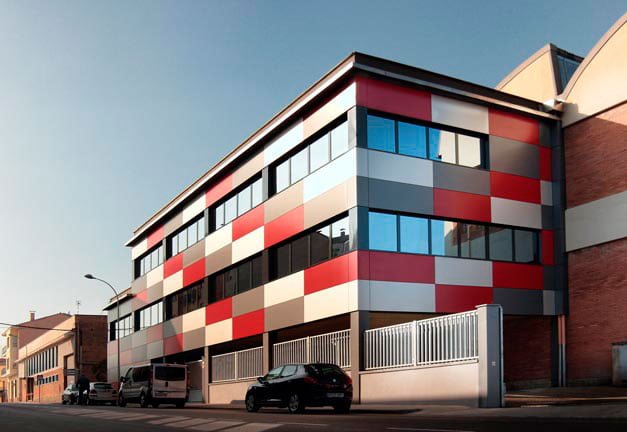
We supply composite panels manufactured with certified alloys that determine the strength, durability and final quality of your facade. The four-digit numerical coding allows you to identify the mechanical properties and purity level of the aluminum used in your project.
5xxx Series – Composite panel of the highest quality
Magnesium is the main element in this series, which results in a high-strength, work-hardenable alloy.
Superior performance: Magnesium is a more effective hardener than manganese (0.8% Mg equals 1.25% Mn), allowing higher levels of hardness without brittleness.
Resistance in marine environments: They possess excellent anti-corrosion capability in saline environments, being the standard technical choice for coastal projects.
Structural durability: They maintain their mechanical properties as long as they are not exposed to extreme temperatures for a prolonged period of time.
3xxx Series – Medium quality composite panel
With manganese (between 1% and 1.5%) as a key component, this series offers 20% more mechanical strength than the 1xxx series.
Architectural applications: They are widely used in cladding panels for the construction and culinary industry due to their balance between cost and strength.
Workability: These alloys are not heat-treatable but have an excellent response to the forming of trays and cassettes.
1xxx Series – Decorative composite panel
Composed of aluminum of purity equal to or greater than 99.00%. Although it offers excellent corrosion resistance and high conductivity, its mechanical properties are limited.
Recommended use: Decorative applications, luxury packaging and electrical components. It is considered of low quality for structural facades due to its low tensile strength.
Other series and special technical applications
We have specific solutions for every engineering and architectural design need.
2xxx Series (Aluminum-Copper): Requires heat treatment to achieve mechanical properties superior to carbon steel. It is sensitive to intergranular corrosion if not properly treated.
4xxx Series (Aluminum-Silicon): Silicon reduces the melting range, making it ideal for welding wires. In architecture, it is highly valued because it acquires a dark charcoal gray color after anodizing processes.
6xxx Series (Magnesium and Silicon): Heat treatable alloys with high formability and corrosion resistance. They are the standard for frames, windows and structures in the architectural industry due to their excellent texture after anodizing.
7xxx Series (Aluminum-Zinc): Used in high voltage parts and fuselages (duralumin). It offers very high mechanical strength, ideal for the aerospace industry and mobile equipment subject to fatigue.
8xxx series (Other alloys): Includes variants with iron to improve creep resistance or with lithium to reduce density, very common in heat exchangers and high-tech components.